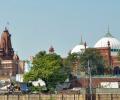
The Allahabad high court Thursday directed the lower court concerned to decide within four months the temporary injunction application as well as a plea for bunching together the trial in all pending cases related to the Shri Krishna Janmabhoomi-Shahi Idgah mosque dispute.

Efforts to resolve three major religious site disputes in Uttar Pradesh - Gyanvapi, Sri Krishna Janmabhoomi-Shahi Eidgah, and Sambhal Shahi Jama Masjid - through out-of-court settlements have failed, with all parties insisting on judicial adjudication.

The Allahabad High Court has requested the Uttar Pradesh government to respond to a petition filed by Ashutosh Maharaj, challenging the opening of his history sheet by the police. Maharaj, who is also involved in the Shahi Idgah-Krishna Janmabhoomi dispute, claims his name should be removed from the police surveillance register.

The Supreme Court has deferred the hearing on the Krishna Janmabhoomi-Shahi Idgah mosque dispute in Mathura. The adjournment comes as Hindu parties involved in the case are reportedly engaged in off-the-record talks to determine which lawsuit will serve as the lead case. The court was hearing a plea challenging an Allahabad High Court order that designated one Hindu party as the representative for all Lord Krishna devotees.

Both Hindu and Muslim parties involved in the Gyanvapi dispute have rejected the Supreme Court's mediation initiative, stating that the matter should be resolved through judicial adjudication. This decision came during a session at a Varanasi court, where both sides expressed their preference for a court verdict over an out-of-court settlement.
The Allahabad High Court dismissed a plea seeking the use of 'disputed structure' instead of 'Shahi Eidgah Mosque' in Mathura case proceedings.

During the hearing on Tuesday, the bench said it has not received the information from the high court yet.
The Supreme Court of India will hear a plea from the mosque management committee challenging an order rejecting its petition in the Krishna Janmabhoomi-Shahi Idgah dispute in Mathura, Uttar Pradesh on January 15. The Allahabad High Court had rejected the mosque committee's plea, stating that the religious character of the Shahi Idgah mosque needed to be determined. The case involves claims that the mosque was built after the demolition of a temple, a claim disputed by the mosque committee. The Supreme Court will now decide on the maintainability of the mosque committee's plea.

The Supreme Court of India has extended its stay on a court-monitored survey of the Shahi Idgah Mosque complex in Mathura, which is located adjacent to the Krishna Janmabhoomi temple. The court deferred the hearing on a plea against the survey to April 1, while the interim order staying the survey will continue to operate. The Hindu side claims that the mosque complex holds signs of a temple that once existed at the site, while the Muslim side contends that the lawsuits filed by the Hindu litigants violate the Places of Worship (Special Provisions) Act of 1991.

The Supreme Court on Friday refused to stay the proceedings before the Allahabad high court on suits related to the Sri Krishna Janambhoomi-Shahi Idgah dispute, saying it will not be fair to interfere with the high court order without hearing both the sides.
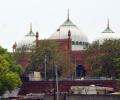
The objections against the suit were raised by the management committee of the mosque and the Uttar Pradesh Sunni Central Waqf Board.

The hearing of the civil suit filed in a Mathura court seeking ownership of the entire 13.37 acres of Krishna Janmabhoomi land has been adjourned till December 10, after the plaintiff in the case, Shri Krishna Janmabhoomi Trust, failed to appear before the court on Wednesday.
The Allahabad High Court has rejected an application to implead goddess Radha Rani as a party in the Mathura Krishna Janmabhoomi-Shahi Idgah title dispute. The court ruled that puranic illustrations are considered hearsay evidence and the applicant failed to provide concrete evidence supporting the claim of joint ownership.
The Hindu litigants claim the mosque holds signs suggesting that it was a temple once.
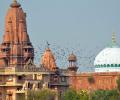
The Supreme Court refused to stay Allahabad high court's December 14 order which allowed the primary survey of the Shahi Idgah complex adjacent to the Shri Krishna Janmabhoomi Temple in Uttar Pradesh's Mathura by a court-monitored three-member team of advocate commissioners.
The fast-track court of the civil judge (senior division) has posted the matter to April 17 for further hearing.
"Interim orders wherever granted shall continue. Re-list in first half of April, 2024," the bench said in its order and directed the parties to complete the pleadings by then.
The court said the modalities of the survey will be discussed at the next hearing on December 18.

A bench of Justices Sanjiv Khanna and Dipankar Datta stayed the implementation of the December 14, 2023, order by which it had agreed to the appointment of a court commissioner to oversee the survey of the mosque premises which, the Hindu side claims, hold signs suggesting that it was a temple once. However, the apex court made it clear that proceedings before the high court in the dispute including the maintainability of the suit under Order 7 Rule 11 of the Civil Procedure Code (CPC) will continue.
Mathura has a prominent mosque -- the Shahi Idgah -- located next to a temple, believed to be the site of the birthplace of Lord Krishna. The mosque has been at the centre of a legal battle for years with Hindu groups claiming that the Idgah was built on land where Lord Krishna was born.
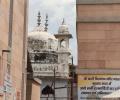
The Supreme Court's 2023 order refusing to stay a scientific survey at the Gyanvapi Mosque complex has sparked claims over several other disputed places of worship across India. This has led to several court cases, including one in Mathura where a survey of the Shahi Idgah Mosque complex was ordered, and another in Ajmer where a claim was made that a Shiva temple existed within the dargah of Sufi saint Moinuddin Chishti. The article also highlights a dispute over the Bhojshala in Madhya Pradesh, which Hindus consider a temple and Muslims consider a mosque. The Supreme Court's order has reignited debates about the Places of Worship (Special Provisions) Act, 1991, which prohibits the change of character of religious places as they existed on August 15, 1947.
The apex court rejected an appeal challenging a July 10 decision of the Allahabad high court which had also dismissed the plea finding no error or illegality in the order of a Mathura civil judge who had decided to first hear the issue of maintainability of the suit as raised by management committee of the mosque.

The Act prohibits conversion of any place of worship and to provide for the maintenance of the religious character of any place of worship as it existed on August 15, 1947.

Alok Kumar said that all the required medical facilities and other arrangements will be provided to Advani during his visit to the Pran Pratistha ceremony in Ayodhya.
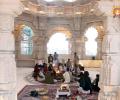
'They are from the north, east, west, south and northeast part of India. They will be the 'mukhya yajmaan' (main hosts)'
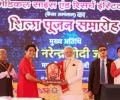
'While suppression of information is acceptable for the government, the Opposition's efforts at pinning the government and its leaders is labeled anti-national,' points out Nilanjan Mukhopadhyay.
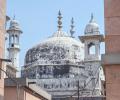
The Places of Worship Act is 'An Act to prohibit conversion of any place of worship and to provide for the maintenance of the religious character of any place of worship as it existed on the 15th day of August 1947, and for matters connected therewith or incidental thereto'.
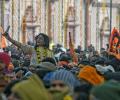
'Divine experience and a proud moment' is how the 15 couples who were the 'mukhya yajman' for the consecration ceremony at the Ram temple in Ayodhya described the grand event and said that the day will be forever etched in their memories.

Mohan Bhagwat said the temple would be constructed in the same grandeur as it existed before, using the "same stones" under the guidance of those who were the flag-bearers of the Ram Janmabhoomi movement for the last 25 years.
The Supreme Court on Friday agreed to hear on September 9 a plea challenging certain provisions of the 1991 law which prohibit filing of a lawsuit to reclaim a place of worship or seek a change in its character from what prevailed on August 15, 1947.
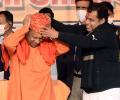
A magnificent Krishna Janambhoomi temple in Mathura was a recurrent theme for the ruling BJP in the run-up to the assembly polls, reports Nitin Kumar.
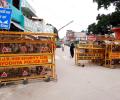
Unlike in the past, the Vishwa Hindu Parishad is not celebrating any "Shaurya Diwas" (Bravery Day) on Tuesday and there are no plans by the Muslim community to observe a "Black Day".
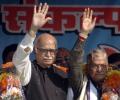
According to trust sources, Union Home Minister Amit Shah, Defence Minister Rajnath Singh, Rashtriya Swayamsevak Sangh chief Mohan Bhagwat , Maharashtra Chief Minister Udhav Thackeray and Bihar CM Nitish Kumar are also on the list of invitees.
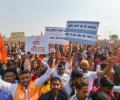
The verdict on the temple-mosque land dispute is expected to be pronounced before Chief Justice of India Ranjan Gogoi retires on November 17.

The meeting is seen as part of efforts by the RSS and the BJP to reach out to the Muslim community and send out a message of peace and harmony.

Mahesh Sharma Lord Ram looked set to occupy political centre-stage in poll-bound Uttar Pradesh despite the Bharatiya Janata Party's claim of a temple to the deity not being on its agenda

The government has identified three circuits -- Ramayana Circuit, Krishna Circuit and Buddhist Circuit - to boost religious tourism. The Ram museum will be a part of the Ramayana Circuit for which the Centre has sanctioned Rs 225 crore, with Rs 151 crore exclusively for Ayodhya, which is the hub of the circuit.

Rediff.com gives you a look at newbies in the Council of Ministers
